SKU: 94241447560

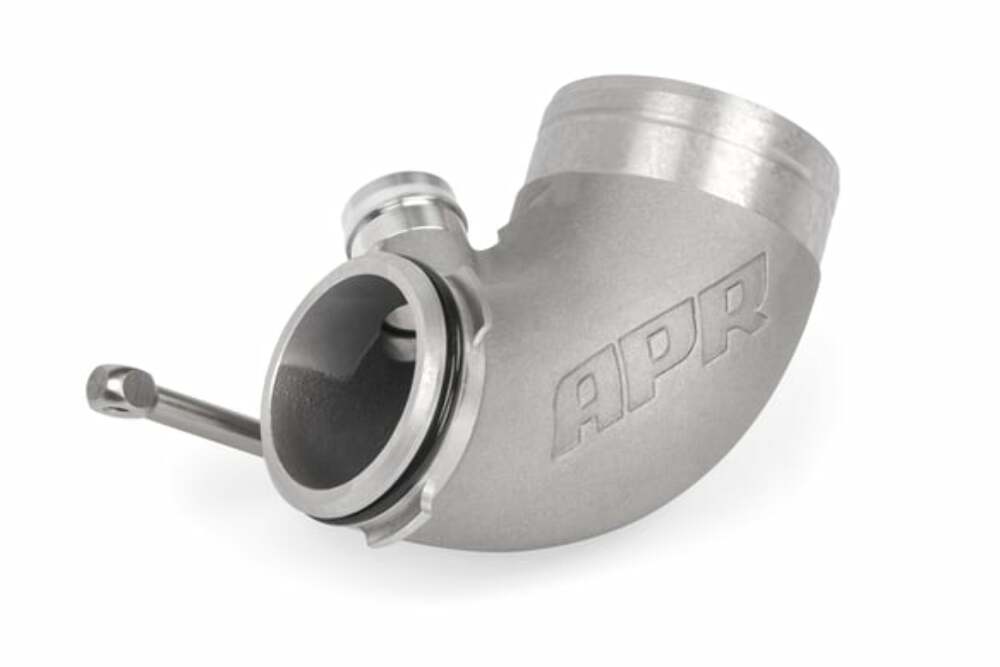
APR Turbo Inlet Pipe - 1.8/2.0T - MQB - MS100137

Sale price$100.32 Regular price$111.47
Save 10%

Pay in installments of $27.87 with ShopPay, AfterPay and Klarna

Shipping Estimate
USA
  • USA
  • CAN

Ships within 48 hours · Estimated delivery Sep 3 - Sep 8

Promo Codes Available:

For Your Every Summer RSVP, with Code: SUMMER15

Description

APR Turbo Inlet Pipe - 1.8/2.0T - MQB - MS100137Overview: The APR Turbo Inlet Pipe is an easy to install bolt on upgrade that eliminates a restriction before the turbocharger. Unlike fabricated units on the market today, ours is cast from aluminum, allowing for an organically shaped inlet that transitions gradually over a large distance. Such a design promotes better flow rather than abruptly reducing at the turbocharger's inlet like other units. It's larger than stock throughout, removes a large

Overview:

The APR Turbo Inlet Pipe is an easy-to-install bolt-on upgrade that eliminates a restriction before the turbocharger. Unlike fabricated units on the market today, ours is cast from aluminum, allowing for an organically shaped inlet that transitions gradually over a large distance. Such a design promotes better flow rather than abruptly reducing at the turbocharger's inlet like other units. It's larger than stock throughout, removes a large internal restriction at the PCV inlet, and outflows the factory unit allowing the turbocharger to operate more efficiently. We fully assemble each unit with a billet securing arm, billet PCV bung and new o-ring. The inlet and outlet are CNC-machined to control tolerances and ensure snug and secure connections. This upgrade is recommended at all stages utilizing an IHI IS12, IS20 or IS38 turbocharger!

Features:

  • Cast aluminum construction
  • Outflows the factory unit: 441 cfm vs 379 cfm @ 28" of H2O
  • Larger internal diameter throughout
  • CNC-machined inlet and outlet
  • CNC-machined billet-stainless-steel securing arm
  • CNC-machined billet-aluminum PCV bung
  • New o-ring
  • Easy-to-install direct-bolt-on design

Application:

Year Make Model Submodel Engine Size
2016 Volkswagen Golf Base 110/1.8L L4
2015 Volkswagen Golf Launch Edition 110/1.8L L4
2017 Volkswagen Golf Wolfsburg Edition 110/1.8L L4
2016 Volkswagen Golf SportWagen Limited Edition 110/1.8L L4
2017 Volkswagen GTI Sport 121/2L L4
2019 Volkswagen Arteon SEL R-Line 121/2L L4
2019 Volkswagen Arteon SEL Premium R-Line 121/2L L4
2019 Volkswagen Arteon SEL 121/2L L4
2019 Volkswagen Arteon SE 121/2L L4
2019 Volkswagen Jetta GLI S 121/2L L4
2019 Volkswagen Jetta GLI Autobahn 121/2L L4
2019 Volkswagen Jetta GLI 35th Anniversary Edition 121/2L L4
2019 Audi A3 Titanium 121/2L L4
2019 Volkswagen GTI Rabbit Edition 121/2L L4
2018 Volkswagen Atlas SE 121/2L L4
2018 Volkswagen Atlas SEL 121/2L L4
2015 - 2016 Volkswagen Golf SEL 110/1.8L L4
2015 - 2016 Audi A3 Prestige 110/1.8L L4
2015 - 2016 Audi A3 Premium Plus 110/1.8L L4
2015 - 2016 Audi A3 Premium 110/1.8L L4
2018 - 2019 Volkswagen Atlas S 121/2L L4
2017 - 2019 Volkswagen Golf Alltrack S 110/1.8L L4
2017 - 2019 Volkswagen Golf Alltrack SE 110/1.8L L4
2017 - 2019 Volkswagen Golf Alltrack SEL 110/1.8L L4
2017 - 2019 Audi A3 Prestige 121/2L L4
2017 - 2019 Audi A3 Premium Plus 121/2L L4
2017 - 2019 Audi A3 Premium 121/2L L4
2015 - 2018 Volkswagen Golf S 110/1.8L L4
2015 - 2018 Volkswagen Golf SE 110/1.8L L4
2015 - 2018 Volkswagen Golf SportWagen SE 110/1.8L L4
2015 - 2018 Volkswagen Golf SportWagen SEL 110/1.8L L4
2016 - 2019 Audi TT Quattro Base 121/2L L4
2015 - 2019 Volkswagen Golf SportWagen S 110/1.8L L4
2015 - 2019 Audi S3 Prestige 121/2L L4
2015 - 2019 Audi A3 Quattro Prestige 121/2L L4
2015 - 2019 Audi A3 Quattro Premium 121/2L L4
2015 - 2019 Audi A3 Quattro Premium Plus 121/2L L4
2015 - 2019 Volkswagen GTI S 121/2L L4
2015 - 2019 Volkswagen GTI Autobahn 121/2L L4
2015 - 2019 Volkswagen GTI SE 121/2L L4
2015 - 2019 Audi S3 Premium Plus 121/2L L4
2015 - 2019 Volkswagen Golf R Base 121/2L L4

Specs:

Brand APR
Emission Code 4
Material Carbon Fiber
Product Type Intake Pipe
Warning California Proposition 65
Shipping Notes
  • Free Standard Shipping on $100+ Orders to the USA.
  • Except Preorder products are shipped in 48 hours.
  • Delivery to the USA:
  1. Standard Shipping : 3-10 business days
  • If time is of the essence, please consider selecting expedited delivery for faster service.
Exchange/Return Notes
  • We offer a 30-day return/exchange service after receiving.
  • Final sale items are not eligible for returns or exchanges.
  • To process your return/exchange, please contact us at [email protected]
  • Please click here for more details>>> Return & Exchange Policy
SKU: 94241447560

Discover Niche Categories That Outsell

Top-Converting Item to Boost Your Average Order

4.8 ★★★★★
Based on 24 reviews
Sort
Highest Rating
Newest First
Oldest First
Product Reviews
W
Verified Purchase
William H Vickers
Chelsea, US
★★★★★ 5
The Spirit Realm is Real!
Format: Kindle
Great little book with a big powerful message! If you are seeing things in the spirit that others don't see and you're not sure what to do about it, this book is for you!
WAS THIS REVIEW HELPFUL?YesReportShare
Reviewed in the United States on May 22, 2025
S
Verified Purchase
S.B.
Grantham, US
★★★★★ 5
Great, easy to understand explanations
Format: Kindle
I definitely needed this! I have been enduring a long period of spiritual attacks in the natural and physical realms. It has helped me to better understand my calling, even though I have been serving God as a spirit filled and spirit baptized follower of Yeshua.
WAS THIS REVIEW HELPFUL?YesReportShare
Reviewed in the United States on February 26, 2025
T
Verified Purchase
Trader Dave
Omaha, US
★★★★★ 5
Easy to read. Line spacing is just right! Thank you!
Format: Paperback
Michael Van Vlymen delivers the lived from experience truth once again! Michael is down to earth and matter of fact as he writes. He is heavenly minded every day! I've grown more in love with Jesus because of his testimony of heavenly realms operating on the earthly realm. My eyes have been opened much much more as I listen and read Mikes well illustrated books and videos!
WAS THIS REVIEW HELPFUL?YesReportShare
Reviewed in the United States on February 24, 2025
O
Verified Purchase
Online shopper
Natrona Heights, US
★★★★★ 5
Challenge Accepted
Format: Kindle
I liked the book. It challenged my position of focusing on the light and ignoring the darkness. It challenges me to desire the whole experience of spiritual awareness and sight and to become adept in living as a watchman.
WAS THIS REVIEW HELPFUL?YesReportShare
Reviewed in the United States on March 11, 2025
T
Verified Purchase
Tim Chaffey
San Leandro, US
★★★★★ 5
Outstanding, compelling, and thorough work on the historicity or non-historicity of the Resurrection of Jesus
Format: Paperback
I had been looking forward to reading this book since the first time I heard about it. I was sitting in Dr. Gary Habermas' class on miracles and he told us about Mike Licona, who was currently working on his dissertation on the Resurrection. Although it was published in 2010, I finally had the opportunity to read it over the past few months. At over 700 pages, including an extensive bibliography and over 2,000 footnotes, this book is not a light read by any stretch of the imagination. As the subtitle states, this is a book dealing with historiography. Readers looking for a deep theological treatment on the Resurrection of Christ may want to look elsewhere since Licona's focus here is not theology, but history (although there is still a good deal of theology). Using methodological principles agreed upon by a vast number of historians from a variety of religious and philosophical backgrounds, he sets out to determine whether or not the historian "is warranted in regarding Jesus' resurrection as an event that occurred in the past" (p. 610). Surprisingly, the book consists of only five chapters and one appendix, so each chapter averages more than 100 pages in length. Also, the second half of the book contains a significant amount of Greek, giving me a good opportunity to brush up on that. If you can't read Greek, don't worry, Dr. Licona provides an English translation throughout. The first section deals with a significant number of preliminary considerations. There is an excellent critique of the skeptical postmodern view of history and a complete dismantling of the beliefs of Jesus "mythers" (those who claim Jesus never existed). There's also a good discussion on horizons (the presuppositions and biases we all have). While total neutrality may not be possible, Licona gives several principles historians should implement to help them transcend their horizon. Finally, he provides an honest discussion of his own biases so that readers are well aware of where he is coming from. The second chapter focuses on whether or not miracles fall within the purview of the historian. Licona addresses the popular objections of David Hume and Bart Ehrman, as well as McCullagh, Meier, Wedderburn, and Dunn. Many skeptics simply have an a priori objection to miracles, so they aren't willing to even consider the possibility that historical evidence for a miracle may exist. There's an interesting discussion on the burden of proof as it relates to the historicity of miracle claims. I thought the following quote summarized the nature of evidence when it comes to miracle claims: "It is the responsibility of the historian to consider what the evidence would look like if she were not wearing her metaphysical bias like a pair of sunglasses that shade the world. It is not the responsibility of the evidence to shine so brightly that they render such glasses ineffectual." (p. 196) With all the preliminary matters out of the way, Dr. Licona gets down to the business of doing history. Chapter three examines the historical sources pertaining to Christ's Resurrection. Many Christians may object to the methodology employed in this chapter since he does not automatically accept every biblical passage on the subject as evidence, but bear in mind that Licona is doing his best to transcend his own Christian horizon to be as neutral as possible. He discusses over two dozen early sources and rates them as "unlikely, possible-minus, possible, possible-plus, highly probable, indeterminate [or] not useful" (p. 201). The fourth chapter uncovers the historical bedrock pertaining to the fate of Jesus. This approach follows on the heels of the exhaustive work of Dr. Habermas who, since 1975, has kept track of over 3,400 academic works from scholars of various stripes on the Resurrection in English, German, and French. From this research, Dr. Habermas has shown that there are 12 facts accepted by the vast majority of scholars. He has reduced this to six best attested details in what he calls the "minimal facts" approach. Each of these facts are discussed, but Dr. Licona narrows this down to three facts that nearly all scholars agree upon: 1) Jesus died by crucifixion, 2) the disciples had experiences that led them to believe and proclaim that Jesus had risen from the dead, and 3) Paul converted to Christianity after experiencing what he believed to be a post-Resurrection appearance of Jesus. There's also a lengthy discussion on what "resurrection" meant to Jewish and Christian audiences in the first century. The information contained in this chapter is often completely ignored by agnostics, atheists, Muslims, and others who do not want to even consider the Resurrection as a possibility. I have had many discussions with skeptics who display naivete when they claim that there is no evidence to support the claim that Jesus rose from the dead. It's one thing to disbelieve in the event, but it's an entirely different thing to completely ignore or to willingly remain ignorant of the historical bedrock pertaining to the fate of Jesus. The fifth and final chapter of the book examines six different hypotheses that attempt to explain what happened to Jesus after being crucified. Along with the traditional Christian understanding of the Resurrection, the views promoted by Vermes, Goulder, Ludemann, Crossen, and Craffert are weighed in terms of their explanatory scope, explanatory power, plausibility, the amount of ad hoc elements, and illumination for solving problems associated with the subject. An appendix also examines Dale Allison's work on the Resurrection according to the same criteria. The traditional Resurrection hypothesis is the only view that fulfills all five criteria, and it outdistances the other views by a wide margin. Critics can claim that Licona merely concluded what he hoped to prove, but they must be able to point out flaws in his methodology, since his conclusion most certainly follows from the data when historiographical principles are applied. My biggest concern with the book is found in the fifth chapter. While discussing the strange events described in Matthew 27:51-53, Licona suggested that the passage was not describing historical events but employing apocalyptic language to show that a significant person had died. Such descriptions were not uncommon in the ancient world when describing the death of important people. This comment has set off a wave of criticism from conservative Christian scholars like Norman Geisler and Al Mohler. I disagree with Licona's statement and share some of the same concerns as Geisler and Mohler. But when I consider the context and methodology being used in the book, I don't find it to be quite as grievous an error as some have claimed. Skeptics will undoubtedly continue to dismiss the Resurrection of Christ, but they must deal with the research in this book or they simply are not interacting with the latest scholarship. Dr. Licona's work raises the bar when it comes to the most important subject we could ever study: the Resurrection of Jesus Christ. I highly recommend it for anyone interested in this subject who is up to the task of reading an academic work. I have studied the subject for years, but I still learned a lot and will treasure this book as an extremely valuable resource. Even though I disagree with his take on Matt. 27:51-53, I still need to give the book five stars since I don't need to agree with the author on every point for me to give a positive review and recognize the book's worth.
WAS THIS REVIEW HELPFUL?YesReportShare
Reviewed in the United States on December 30, 2012

recommand products